Between Venice and the hills
Situated in a privileged location near cities such as Venice, Padua and Asolo, the "Agostino Steffani" Conservatory of Castelfranco Veneto is a State Institution of High Culture, originally founded in 1969 as a branch of the Venice Conservatory, and later became autonomous in 1980.
The Conservatory's headquarters is located within the walls of Castelfranco Veneto's medieval historic center and is dominated by Villa Barbarella, which houses the academic and administrative offices, as well as classrooms for teaching. Due to the increase in enrollment, the Conservatory has recently expanded its spaces with the opening of a new location in another place of great historical interest: the restored halls of the ancient Convent of the Cloister of the Servites.
The Conservatory has about fifty classrooms for teaching and study, two studios for electronic music, a lecture and concert hall with a capacity of seventy, and a music library also equipped with audiovisual spaces. There are also rooms for faculty and students, equipped with computers and Internet access.
Concerts, orchestra lessons, opera study and numerous other activities also take place in another historically significant venue: the beautiful 18th-century Academic Theater, located in the heart of the city.
The Conservatory of Castelfranco Veneto offers a wide range of instrument courses, including some instruments not commonly taught at other conservatories, such as the accordion and viola da gamba.
Conservatory of Music "Agostino Steffani" - Castelfranco Veneto
The "Agostino Steffani" Conservatory of Castelfranco Veneto is a Higher Institute of Music Studies recognized as a State Institution of High Culture. Founded in 1969 as a branch of the Venice Conservatory, it gained autonomy in 1980.
The Conservatory's main campus is located within the walls of Castelfranco's medieval historic center, dominated by the striking Villa Barbarella, which houses the administrative and teaching offices as well as numerous classrooms for teaching. As a result of the increase in enrollment, new spaces have recently been activated at the restored halls of the old Servite Cloister Convent, which is also of considerable historical interest.
The Conservatory has about fifty classrooms for teaching and study, an electronic music studio, a lecture and concert hall with seventy seats, a music library with dedicated audiovisual spaces, as well as computerized classrooms for students and faculty with Internet access. Orchestral activities, opera study classes, and numerous other events also take place in the prestigious 18th-century Academic Theater, one of the landmarks of the city's cultural life.
The Conservatory's educational offerings are particularly broad and include instruments not commonly taught at other institutions, such as the accordion, viola da gamba and Celtic harp.
The Production Office organizes about 150 events each year, both in the local area and in other Italian cities and abroad. For many years it has curated the concert season In a Classical Key at the Teatro Accademico in Castelfranco Veneto, featuring high-profile artists. In collaboration with the Conservatory, the Jazz Festival, the Sax Festival and the Guitar Festival.
The International Relations Office constantly strives to promote the internationalization of the institution and encourage the participation of foreign students and faculty in the Conservatory's most significant activities: from lectures and master classes to concerts and festivals.
Name : CONSCFV
– Country : Italy
– City : CASTELFRANCO VENETO
PIC : 948992905
– Organisation ID : E10065141 – Registration number : .
– VAT number : IT04579340268
– Erasmus Charter for Higher Education Code : I CASTELF01
The Course Catalogue can be consulted on the website page:
Corsi Archive – Conservatorio Steffani
 Scarica il modulo di iscrizione per studio
Scarica il modulo di iscrizione per traineeship
 Invia il modulo compilato a: ufficioerasmus@steffani.it
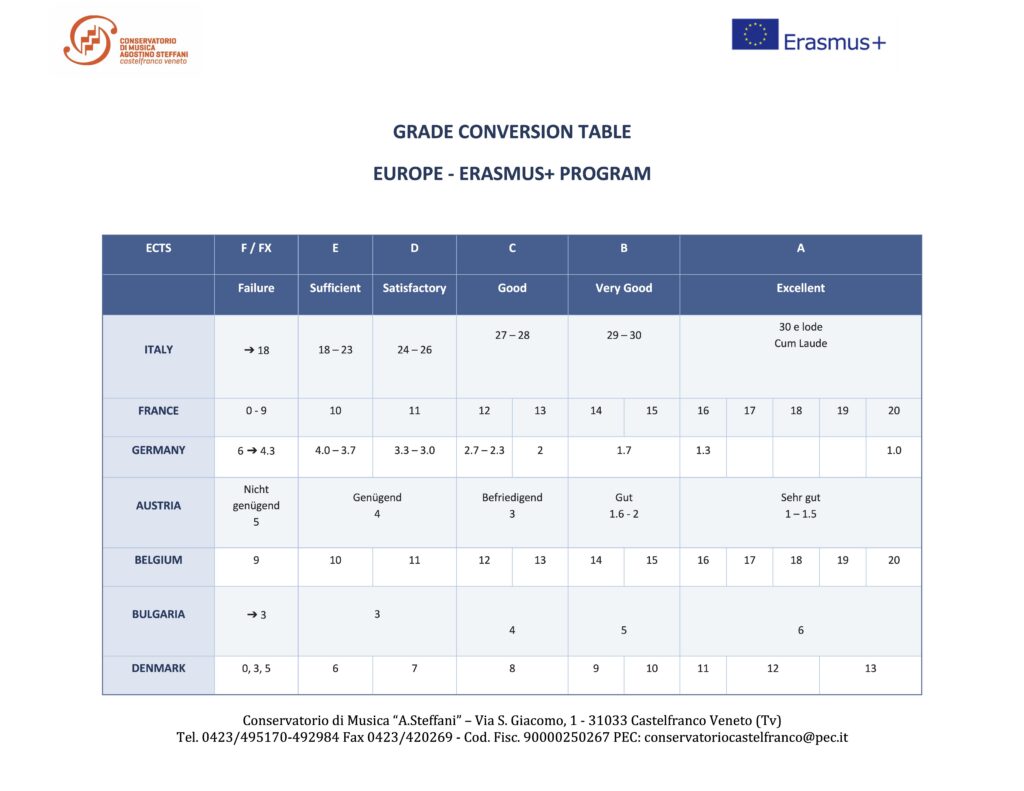
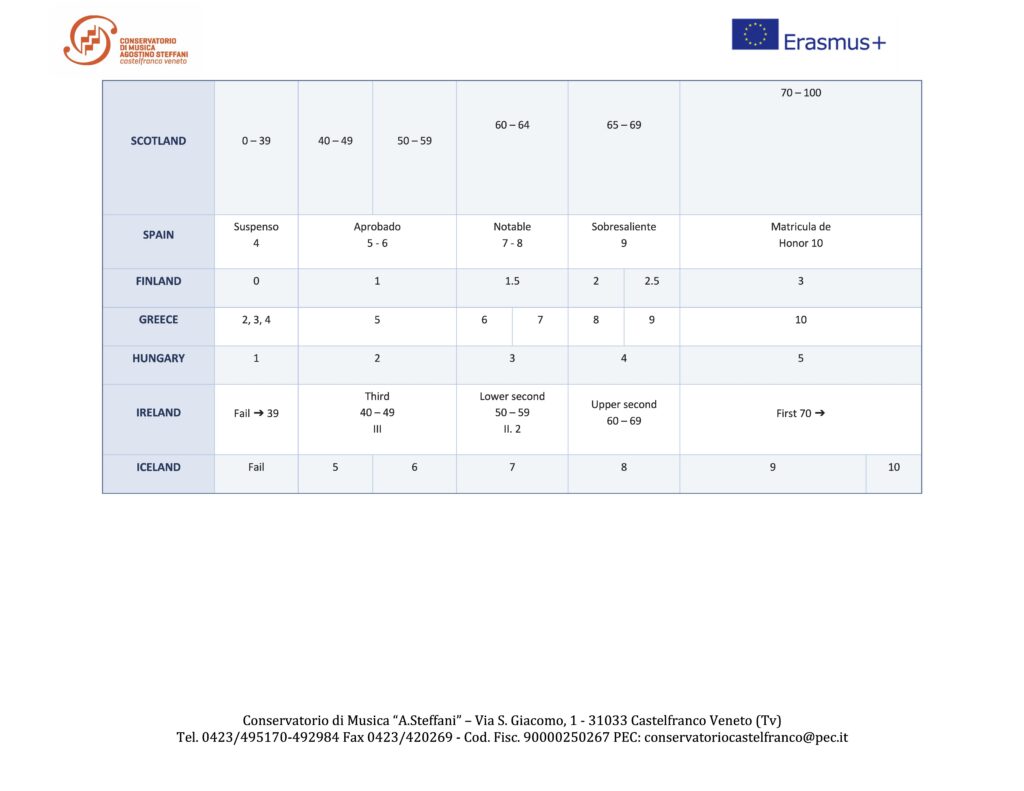
ECTS grade scale
Entry Requirements
Admission to Bachelor's Degree Programs (First Cycle)
A high school diploma is required to enroll in first-cycle courses.
Admission is subject to passing the entrance examination.
Students holding a secondary school degree issued by foreign institutions may be admitted if their degree meets the following general requirements:
(a) the diploma was issued by an educational institution officially recognized by the national education system;
(b) the diploma is valid for admission to university in the country where it was obtained;
(c) the diploma was awarded upon completion of at least 12 years of total study, comprising primary and secondary school.
Admission to Master's Degree Programs (Second Cycle)
To enroll in second-cycle courses, it is necessary to hold a first-cycle degree (Bachelor's degree).
Admission is subject to passing the entrance examination.
Students holding a first-cycle degree issued by a university or college may be admitted if their degree provides access to second-cycle courses in the relevant higher education system.
Castelfranco, the walled city
Castelfranco Veneto owes its name to the "franco" (i.e., tax-free) castle for its early inhabitants-defenders. The imposing red-brick quadrilateral was built in the late 12th century on a pre-existing embankment by the medieval Trevigiani, north of the village of Pieve Nova, on the eastern bank of the Muson River, to defend the unstable border with the territories of Padua and Vicenza.
As early as the first decades of the 14th century, the first built-up area (Bastia Vecchia) developed on the eastern side, with a defensive function as well, housing a hospice for the poor and wayfarers. A walled city by definition, it retains almost its entire medieval walls and six towers, located at the four corners and midpoints of the east and south sides.
From its origins, Castelfranco Veneto has been a city of trade and the site of an ancient grain and cattle market, active until the middle of the last century. In the past it was a center of the most varied craft activities and, from the late 19th century, an important railroad junction.
From 1339 to 1797 it was the seat of the Venetian Podesta. Between the 17th and 18th centuries it was the birthplace of distinguished men of science (Giacomo, Giordano and Vincenzo Riccati), architects (Francesco Maria Preti) and musicians (Agostino Steffani) of international renown.
Castelfranco Veneto is known worldwide as the birthplace of one of the most extraordinary and enigmatic painters in the history of art: Giorgione (1478-1510), a mysterious genius of light and color. Two rare gems attributed with certainty to the master are preserved inside the castle: the Hermetic Friso from Casa Marta-Pellizzari and the famous Pala from San Liberale Cathedral.
Walled city of Giorgione: this is the two-faced icon of Castelfranco Veneto, carved, yesterday as today, in the amazed and enchanted eyes of poets, writers and travelers of all times.
Link
Municipality of Castelfranco Veneto
Giorgione House Museum
Academic Theater
www.castelfrancoveneto.it
Tourist Promotion Consortium
Public National Healthcare Service
European Heath Insurance Card
Partner hotels
Hotel La Torre
Address: Piazza Trento e Trieste, 7, 31033 Castelfranco Veneto TV
Telephone: +39 0423 498707
EMERGENCY PHONE NUMBERS
Carabinieri (Italian military police): 112
Health Emergency Number: 118
Hospital: 0423/7321
Police emergency service: 113
Doctor on duty - Medical Guard: 0423 732753
Road accidents and assistance: 116
Fire Brigade: 115
Taxi service: 336 553115